Ground transportation is one of those business travel categories that rarely gets the strategic attention it deserves until something goes wrong. A missed pickup before a board meeting. A client left waiting at arrivals. An executive team arriving separately at a conference because coordinating vehicles was an afterthought. These aren’t hypothetical scenarios. They happen with regularity, and almost always trace back to the same root cause: treating corporate transportation as a commodity rather than a managed function.
This guide is a practical reference for business travelers, corporate travel managers, and executive assistants who want to understand how professional corporate transportation actually works what it includes, how it’s structured, what it costs, and how to set it up in a way that genuinely supports business operations rather than just completing trips from point A to point B.

Defining Corporate Transportation
Corporate transportation covers the full range of professionally managed ground transport services organized specifically for business purposes. That’s a broader category than many people initially assume.
At one end of the spectrum, it includes the single executive sedan transferring a CEO from Philadelphia International Airport to a hotel in Center City before a board meeting. At the other end, it includes coordinated shuttle systems moving hundreds of employees between office campuses, or charter vehicles transporting a leadership team between venues during a multi-day corporate event.
The common thread across all of it is intentionality. Corporate transportation is pre-arranged, professionally staffed, and designed to operate reliably within the demands of a business schedule. It is not a consumer service adapted for professional use it’s a distinct operating category with its own standards, pricing structures, and service expectations.
What Separates Corporate Transportation from Standard Rideshare
This distinction matters more than many organizations realize, particularly for travel managers evaluating cost.
Guaranteed vehicles. A corporate car service confirms a specific vehicle category at booking. A rideshare platform matches you with whatever driver accepts the request. Those are fundamentally different propositions, especially when the trip has professional stakes.
Professional chauffeurs. Corporate transportation providers employ chauffeurs who have been background-checked, drug-screened, and trained in business etiquette, discretion, and safe driving standards. They wear professional uniforms and understand that their conduct reflects on the company whose guest they’re transporting.
Fixed pricing. Rideshare platforms use dynamic pricing that responds to demand in real time. During high-demand periods Philadelphia Eagles home games, convention weeks at the Pennsylvania Convention Center, holiday travel windows surge pricing can multiply a standard fare by two or three times. Corporate transportation rates are agreed upon at booking and do not change.
Flight tracking. For airport pickups, a professional corporate car service monitors your flight’s actual landing time and adjusts the pickup accordingly. If your flight from Chicago to PHL runs forty minutes late, your chauffeur already knows. No calls required, no scrambling on landing.
Invoicing and account management. Consumer rideshare generates individual digital receipts. Corporate transportation accounts generate consolidated invoices on a defined schedule, with line-item detail appropriate for expense reporting and financial oversight.
The Service Categories Under the Corporate Transportation Umbrella
Understanding what falls within corporate transportation helps travel managers and bookers match the right service to each business need.
Executive Airport Transfers
The most common single booking in corporate transportation. An executive or business traveler needs reliable transportation between Philadelphia International Airport and their hotel, office, or meeting venue with a professional chauffeur, a confirmed vehicle, and the assurance that a flight delay won’t leave them stranded.
For international arrivals at PHL, meet-and-greet service (chauffeur waiting inside baggage claim, often with a name sign) is frequently requested by corporate clients. The gesture of having a professional present upon exit from customs communicates care particularly when the arriving party is a client or visiting executive.
Point-to-Point Executive Transportation
Beyond the airport, corporate travelers in Philadelphia regularly need reliable transport between specific locations: hotel to law firm, office building to client headquarters, convention center to restaurant for a client dinner. Point-to-point executive transportation covers all of these with a fixed rate and a professional vehicle confirmed in advance.
For executives with back-to-back meetings across multiple Philadelphia locations perhaps moving from a Center City office to a pharmaceutical campus in King of Prussia and then to a dinner at a Main Line restaurant hourly booking with a chauffeur on standby is the appropriate structure.
Corporate Event Transportation
Annual conferences, client summits, executive retreats, and offsite team events all generate concentrated transportation needs that exceed what standard booking can handle efficiently. Corporate event transportation involves coordinated vehicle deployment, often with multiple vehicles running on a defined schedule, to move groups of participants between venues reliably.
The Pennsylvania Convention Center hosts hundreds of corporate events annually. Companies regularly need transportation from downtown Philadelphia hotels to the convention center, to satellite dinner venues, and back all on a precise schedule. Managing this with individual rideshare bookings for dozens of attendees is logistically chaotic and frequently more expensive per head than a coordinated vehicle solution.
Employee and Executive Shuttle Services
Larger organizations sometimes establish recurring shuttle arrangements for executive commutes or employee transportation between office locations. This structure works particularly well for companies with campuses outside Center City in the Conshohocken corridor, along the Main Line, or in suburban Delaware County where reliable daily transportation for leadership reduces the cumulative cost and friction of individual bookings.
Vehicle Selection for Corporate Needs
Matching the vehicle to the specific trip is where good travel management shows.
| Vehicle Type | Passenger Capacity | Best Use Case |
|---|---|---|
| Executive Sedan | 1–3 | Solo or paired executive travel, airport transfers |
| Luxury SUV | 1–4 | Small groups, families, extra luggage volume |
| Mercedes-Benz S-Class | 1–2 | C-suite, VIP client transport, high-stakes arrivals |
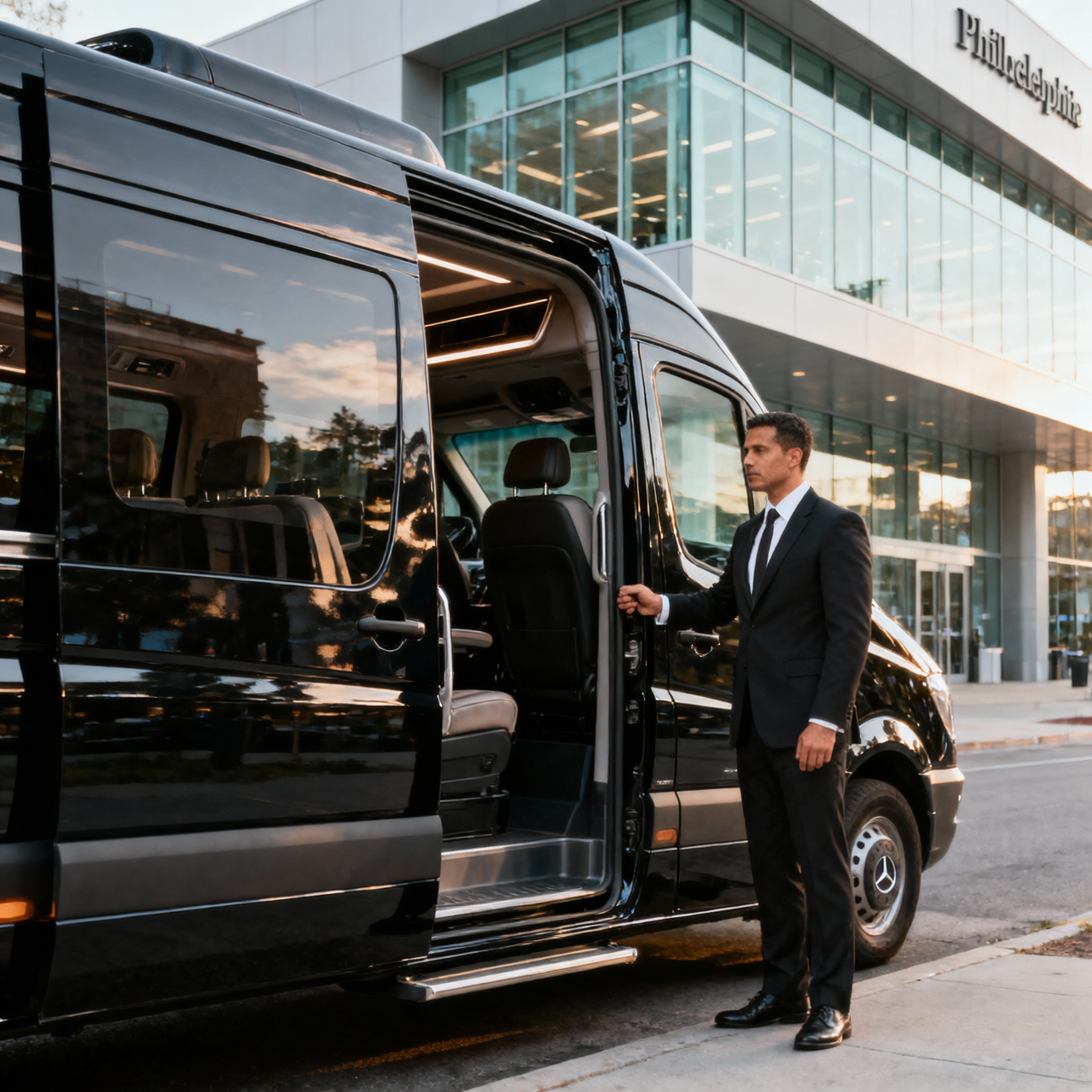
| Sprinter Van | 6–14 | Corporate groups, event transport, team travel |
A solo CFO traveling to a client meeting warrants an executive sedan or, depending on the relationship being managed, a Mercedes-Benz S-Class. A team of eight executives attending an offsite leadership summit requires a Sprinter van — one vehicle, one timeline, no coordination overhead. Using four sedans for the same eight-person group is both more expensive per head and more logistically complicated.
How Corporate Transportation Is Priced
Pricing in this category follows two structures: point-to-point and hourly.
Point-to-point covers a defined origin and destination at a fixed rate. The most common structure for airport transfers, hotel pickups, and single-meeting transport. The rate is confirmed at booking and does not vary with traffic conditions or time of day.
Hourly bookings cover a defined window — typically with a three-hour minimum — during which the vehicle and chauffeur are exclusively available to the client. This structure suits executives with variable schedules, event-day transportation where timing shifts throughout the day, and multi-stop itineraries.
Approximate 2025 market rates for the Philadelphia region:
| Vehicle | Approximate Hourly Rate | Airport Transfer Starting Rate |
|---|---|---|
| Executive Sedan | ~$100/hr | From $100 |
| Luxury SUV | ~$125/hr | From $125 |
| Mercedes-Benz S-Class | ~$150/hr | From $150 |
| Sprinter Van | ~$175/hr | From $175 |
Full-day bookings covering eight to ten hours typically range from $800 to $1,750 depending on vehicle type. Professional gratuity for chauffeurs is customary at fifteen to twenty percent of the fare.
Building a Corporate Account: What to Expect
For companies with recurring transportation needs, establishing a corporate account with a professional provider creates operational advantages that go beyond individual bookings.
Consolidated billing. Instead of processing individual expense receipts across multiple travelers and trips, a corporate account produces centralized invoices at defined intervals. This reduces administrative overhead and gives finance teams clean visibility into ground transportation spend.
Consistent service standards. A corporate account establishes standing preferences — vehicle categories, chauffeur briefing requirements, amenity standards — that apply across all bookings without requiring re-specification each time.
Priority availability. During high-demand periods — holiday travel, major events in Philadelphia, convention weeks — corporate account clients typically receive priority in vehicle allocation over last-minute consumer bookings.
Dedicated contact. Professional corporate accounts provide a direct point of contact for last-minute changes, special requests, and real-time coordination. This is substantively different from navigating a consumer app with no human point of contact available.
Philadelphia-Specific Considerations
The Philadelphia market has several characteristics that directly affect how corporate transportation should be planned.
Center City traffic patterns. The dense office corridor between Broad Street and the Schuylkill, combined with the Vine Street Expressway and I-76 interchange, creates reliable congestion during morning and evening rush hours. Executives with 8:00 or 9:00 AM meetings should allow for meaningful extra transit time, particularly when traveling from the western suburbs or Main Line communities.
PHL terminal layout. Philadelphia International is a multi-terminal airport with an internal connector train. Airlines are spread across Terminals A through F, and the correct drop-off or pickup point varies by carrier. A chauffeur service with working knowledge of PHL’s layout handles this efficiently. For corporate clients, confirming the specific terminal at booking prevents the common experience of arriving at the wrong end of the airport.
Convention and event demand spikes. The Pennsylvania Convention Center hosts major pharmaceutical, biotech, and financial services conferences that generate concentrated transportation demand across specific weeks. During these periods, same-day or next-day booking becomes unreliable. Corporate travel managers scheduling ground transportation around conference attendance should book forty-eight to seventy-two hours ahead, not twenty-four.
Suburban executive pickups. A significant proportion of Philadelphia’s corporate leadership lives in Radnor, Wayne, Berwyn, Malvern, and other Main Line communities. Pre-arranged morning car service from these origins to PHL or into Center City is both the most efficient and most professional way to handle executive commutes — and eliminates the productivity loss of driving and parking.
Booking, Cancellations, and Lead Times
A few operational realities worth building into any corporate transportation policy:
Standard lead time: Airport transfers and point-to-point bookings should be confirmed at least twenty-four hours before departure. Hourly bookings and event transportation require forty-eight hours or more.
Peak periods: During major convention weeks, holiday travel windows, and large-scale events in the Philadelphia area, extend lead times to seventy-two hours or more. Vehicle availability tightens significantly during these periods.
Cancellation policy: Standard airport pickups typically allow cancellation up to two hours before scheduled pickup. Hourly and event bookings generally require forty-eight hours’ cancellation notice. Confirm the specific policy at the time of booking and ensure it’s documented in your corporate travel policy.
Modification requests: Changes to pickup times, locations, or vehicle categories are best communicated directly — by phone or email — rather than through automated systems. A professional car service with a dedicated corporate contact handles modifications efficiently and confirms changes in writing.
Amenities That Matter for Business Travel
Corporate transportation isn’t just about the vehicle and the driver. The amenities on board reflect the operating standard of the service and directly affect how productive or comfortable a trip is.
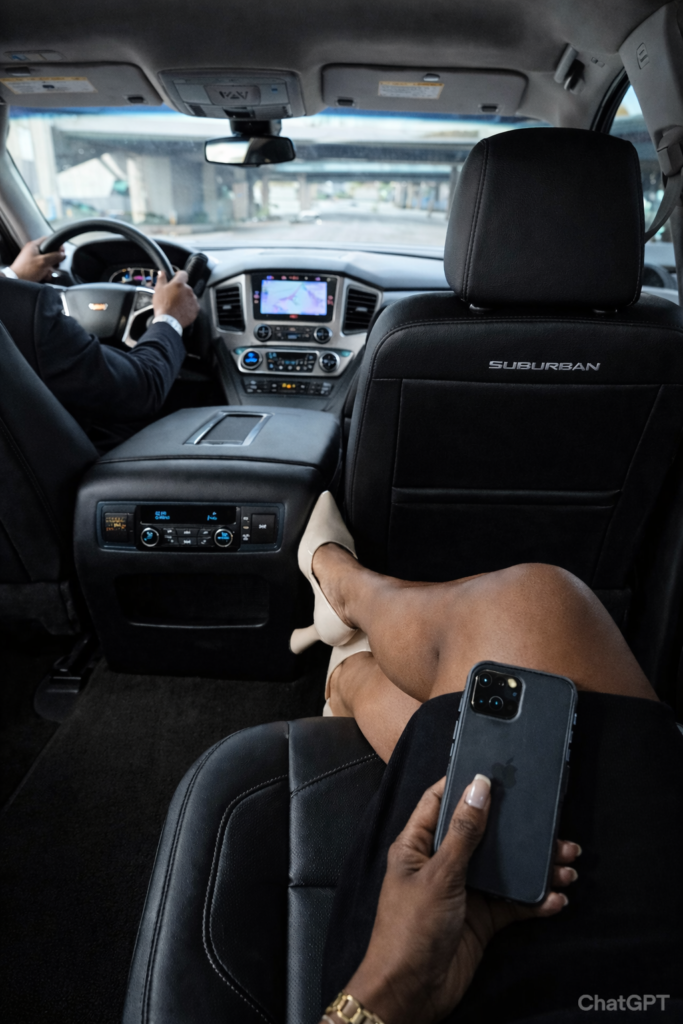
Complimentary bottled water, phone charging (USB and AC), reliable Wi-Fi in equipped vehicles, and a cabin environment quiet enough for phone calls are baseline expectations for professional corporate transport. Climate control calibrated for passenger comfort rather than driver preference, and sufficient legroom for an executive to review documents or prepare during transit, are details that distinguish properly equipped vehicles from generic alternatives.
For client-facing trips, these details matter in ways that are difficult to quantify but easy for clients to notice.
The Operational Case for Getting This Right
Corporate transportation done well is largely invisible — executives arrive on time, clients are collected professionally, and groups move between venues without incident. Done poorly, it becomes the story of the trip. The missed pickup that delayed the meeting. The client who waited thirty minutes outside arrivals. The conference group that arrived in three separate vehicles at three different times.
The operational case for professional corporate transportation isn’t about luxury. It’s about eliminating the variables that introduce risk into business-critical travel. Fixed pricing removes financial surprises. Confirmed vehicles remove availability risk. Professional chauffeurs remove the judgment and conduct variable. Flight tracking removes the timing uncertainty at airport pickups.
Together, these factors create a ground transportation experience that supports business objectives rather than complicating them.
Delux Limousines provides corporate transportation services throughout the Greater Philadelphia region, including airport transfers, executive point-to-point transport, group event vehicles, and corporate account management. Full service details are available at dltsl.com/services.
Setting Up Your First Corporate Booking
If you’re arranging corporate transportation for the first time or establishing a new provider relationship, the process is straightforward. Contact the service directly, specify the trip details — passenger count, luggage requirements, pickup location, destination, date, and time — and confirm the vehicle category and rate before finalizing.
For recurring needs or corporate account setup, a direct conversation with the service’s account team is the most efficient starting point. It allows you to establish preferences, discuss volume, and confirm the booking and billing structure before any individual trips are booked.
Reach out to Delux Limousines at dltsl.com/contact-us to discuss your corporate transportation requirements directly.
Connect with Delux Limousines on LinkedIn or read verified client reviews on Yelp.
Call: 610-871-8784
WhatsApp: 267-988-3392
Email: reservations@dltsl.com